
Starting the Year off Right

Starting the Year off Right
Grace Bible Church Sermon Podcast

Facts on Anxiety

Anxiety disorders are the most common mental illness in the U.S., affecting 40 million adults in the United States age 18 and older, or 18.1% of the population every year.

Generalized Anxiety Disorder (GAD)

GAD affects 6.8 million adults, or 3.1% of the U.S. population, yet only 43.2% are receiving treatment.

Women are twice as likely to be affected as men. GAD often co-occurs with major depression.

Panic Disorder (PD)

PD affects 6 million adults, or 2.7% of the U.S. population.

Women are twice as likely to be affected as men.

Social Anxiety Disorder

SAD affects 15 million adults, or 6.8% of the U.S. population.

SAD is equally common among men and women and typically begins around age 13. According to a 2007 ADAA survey, 36% of people with social anxiety disorder report experiencing symptoms for 10 or more years before seeking help.


"The Bible is a finished and complete revelation entirely sufficient for its divinely intended purpose. It need not be supplemented by reason, experience, tradition, other religions, or anything else. It does not wait to be sufficient until it encounters the individual nor does it cease to be sufficient when rejected or ignored by the same."

Rolland McCune, A Systematic Theology of Biblical Christianity: Prolegomena and the Doctrines of Scripture, God, and Angels, vol. 1 (Allen Park, MI: Detroit Baptist Theological Seminary, 2009), 61.

The Gifts & The Body 25: Koinonia Culture Part 3

The Gifts & The Body 25: Koinonia Culture Part 3
Grace Bible Church Sermon Podcast

Vengeance and the Attributes of God

Omniscience- God knows the entire situation completely, even down to the intentions of each person's heart.

Justice- God knows the exact measurements of the wrong for all parties involved. He is not swayed by opinion and He cannot be "paid off" to render a false verdict.

Goodness- God is compassionate, especially to the wrong-doer! His vengeance against them is tempered with His goodness so that His wrath is exact, not excessive.

Eternality- God has seen every wrong imaginable. He sees our current situation. He promises a complete vindication!

Mercy- God has been wronged in every possible way. Every sin is first and foremost a sin against Him. It is always personal. He is able to sympathize with those who have been wronged because He has been there to a greater degree.

The Body & The Gifts 23: Koinonia Culture Part 1

The Body & The Gifts 23: Koinonia Culture Part 1
Grace Bible Church Sermon Podcast

"The word “spirit” (pneuma (πνευμα)) refers to the human spirit as that part of man which gives him God-consciousness, or to the attitude or disposition of a man, as “that man’s spirit is good,” or to the Holy Spirit. The definite article appears before it in the Greek text. The absence of the Greek definite article emphasizes character. 

If that were absent here, the reference would be to the disposition or attitude of a person. The presence of the article points to the Holy Spirit. It is the locative of sphere. That is, Paul exhorts to fervency in the Christian life which is engendered by the Spirit, not produced by the flesh (self-effort)."

The Body & The Gifts 22: The Spiritual Gift of Mercy

The Body & The Gifts 22: The Spiritual Gift of Mercy
Grace Bible Church Sermons Podcast

The Gift of "Mercy"- "the outward manifestation of pity; it assumes need on the part of him who receives it, and resources adequate to meet the need on the part of him who shows it."

W. E. Vine, Merrill F. Unger, and William White Jr., Vine’s Complete Expository Dictionary of Old and New Testament Words (Nashville, TN: T. Nelson, 1996), 403.


The Gift of "Mercy"- "to feel sympathy with the misery of another, especially such sympathy which manifests itself in action, less frequently in word."

Kenneth S. Wuest, Wuest’s Word Studies from the Greek New Testament: For the English Reader, vol. 1 (Grand Rapids: Eerdmans, 1997), 107.


The Spiritual Gift of Mercy- 

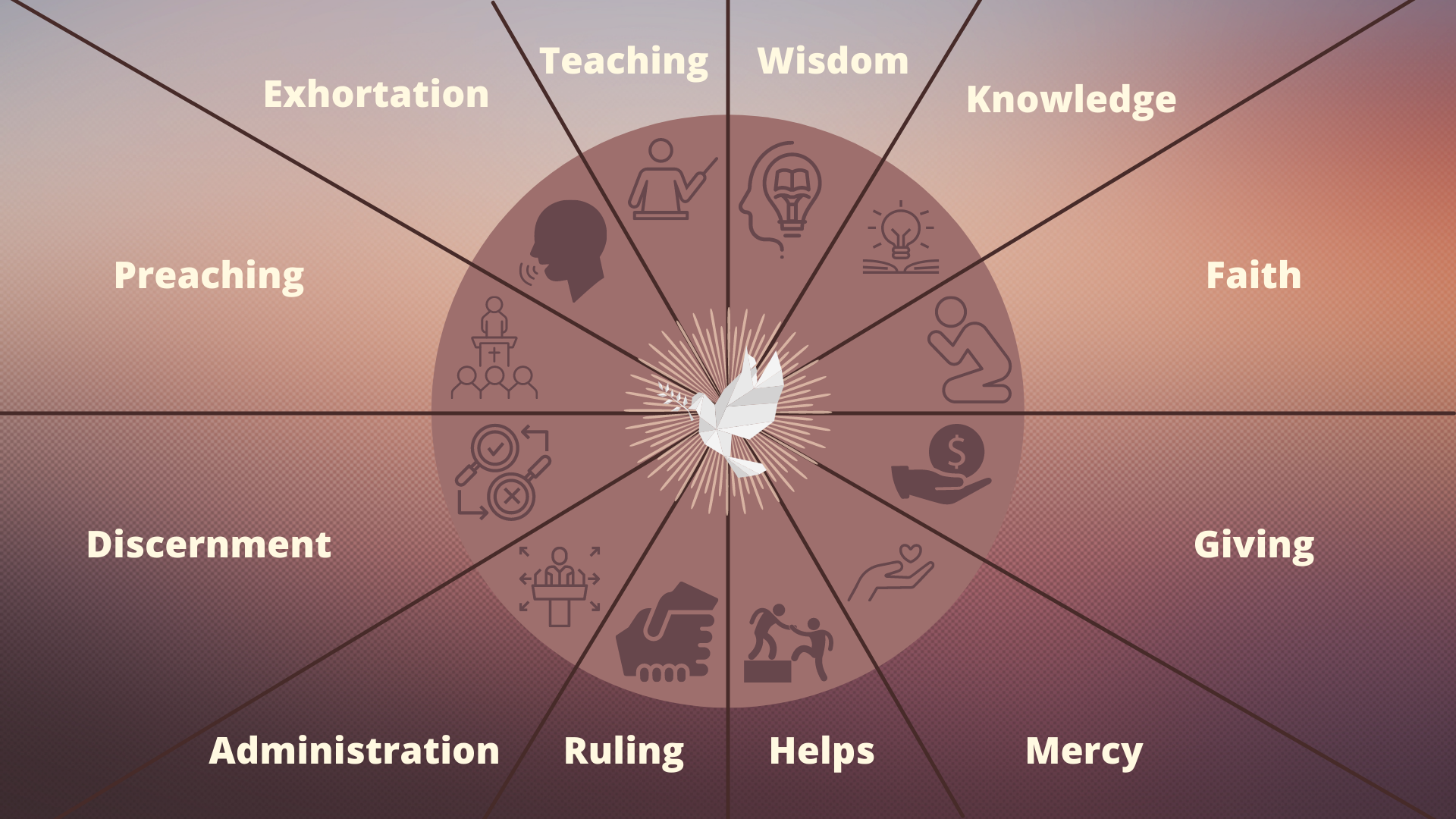
The God-given ability to be sensitive or empathetic to people who are in affliction or misery and to lift internal burdens with cheerfulness. (Romans 12:8)

  • Perceptive to people in need

  • Find it hard to say “no” when asked to help

  • Jump in quickly to help – sometimes without evaluating fully

  • Lay aside personal desires and personal plans to help others

  • A peacemaker

  • Avoid arguments or controversial situations

  • Rely heavily on feelings (sometimes hold them inside)

  • Love people despite their faults

  • Cheerful

  • Try to find the best in people without doubting them


"Mercy is a form of love determined by the state or condition of its objects. Their state is one of suffering and need, while they may be unworthy or ill-deserving. Mercy is at once the disposition of love respecting such, and the kindly ministry of love for their relief."

John Miley, Systematic Theology, Volume 1 (New York: Hunt & Eaton, 1892), 209.

The Body & The Gifts 21: The Spiritual Gift of Leading

The Body & The Gifts 21: The Spiritual Gift of Leading
Grace Bible Church Sermon Podcast

The Gift of "Leading"- proistemi- 

①.- to exercise a position of leadership, rule, direct, be at the head (of)

②.- to have an interest in, show concern for, care for, give aid

"The ability to govern others without 'lording' leadership over them." -Woodrow Kroll

"Administrations" (1 Cor 12:28)- kubernesis- "indicates varieties of such leading positions in the ecclesial body of Christ" (p. 573).

This is the only occurrence of this word in the New Testament.

The one with the gift of administration "is a helmsman who steers a vessel, and thus this gift consists in managing and directing others whether officially as presbyters, pastors, or bishops or in unofficial ways. Some men and some women of the church, including even young people, have this gift to a marked degree and profit the church not a little by rightly putting it to use." -Lenski

The Spiritual Gift of Leading (Administration)- 

The God-given executive ability to lead people with care, while collecting data, setting policy, and developing plans which will guide a course of action with skill and wisdom (Romans 12:8; 1 Corinthians 12:28).

  • Assumes responsibility and stays on course until the work is accomplished

  • Guides the efforts of the team on a project

  • Develops, follows, and/or creates efficient plans

  • Confronts people enthusiastically with the ability to confer, negotiate, and supervise in delegating responsibilities

  • Good organizational skills, getting a high level of efficiency out of people and resources

  • Remains calm in spite of obstacles, finding creative new approaches when needed

  • Expresses opinions freely

"Necessary to the work of the church is the leadership given to it by God. In keeping with this need, the gift of administration and ruling is sovereignly bestowed upon a few (Rom 12:8; 1 Cor 12:28). It is clear that all Christians are on the same level of privilege in spiritual things, but in the providence of God some are given places of great authority. To those possessing the gifts of administration and ruling all Christians should give proper heed, being exhorted to observe such gifts and honor them by obedience (Heb. 13:7)."

John F. Walvoord, The Holy Spirit (Galaxie Software, 2008), 169.

The Body & The Gifts 20: The Spiritual Gift of Giving

The Body & The Gifts: The Spiritual Gift of Giving
Grace Bible Church Sermon Podcast

The Gift of "Giving"- metadidomai- "give (a part of), impart, share."

Ex.- "that I may impart some spiritual gift to you" (Rom 1:11b). 

"Liberality"- haplotes- "simplicity, sincerity, uprightness, frankness" - ‘without strings attached’, ‘without hidden agendas’ -p. 104

“'Liberality' means generosity that is free of any self-serving motive." -Constable

William Arndt et al., A Greek-English Lexicon of the New Testament and Other Early Christian Literature (Chicago: University of Chicago Press, 2000), 638.

The Spiritual Gift of Giving- Radmacher

The God-given ability to make and to give things most liberally and beyond all human expectation. (Romans 12:8; 1 Corinthians 13:3)

  • Dislike emotional appeals, wants the facts

  • Ability to invest wisely

  • Set and achieve long-range goals

  • Use resources to get the most out of them

  • Work to aid those needy people who are worthy of assistance

  • Determines merits of a project before investing or getting others to invest

  • Dislikes waste

  • Make decisions quickly, but holds back when uncertain

"A believer with the gift of giving has the capacity to give of his substance to the work of the Lord or to the people of God consistently, liberally, sacrificially, and with such wisdom and cheerfulness that others are encouraged and blessed."

William J. McRae, The Dynamics of Spiritual Gifts (Grand Rapids, MI: Zondervan, 2010), p. 50-51.